Showing posts with label photography education. Show all posts

Thursday, July 23, 2015

This is why I shoot RAW...

So first of all what the hell is a raw file? raw file is the picture or image as the sensor of the camera sees it. It is like a film negative, in this case a digital negative. Instead of letting the camera take control when you have your file type as a JPEG, you can actually do the processing yourself, and make the image the way you like. 

Now, raw files aren't pretty, it is very easy to be seduced by the over-saturated, over-contrasty image that the JPEG creates; when you look at the back of the camera you think you want your picture to look that way, but in reality the JPEG is compressing all that precious data and dumping pixels into oblivion, where you can never get them back. 

I'm not going to lie, it took me a while to understand the importance of raw files, I mean, why would I want to create more work for myself if the camera was already creating a "pretty good photo" right? Wrong, "pretty good" is not good, "pretty good" is lazy, "pretty good" doesn't let you grow. I was limiting myself to what the camera made for me, and allowing it to take away the possibilities the raw file provides.

Sometimes the change is subtle, some color grading, contrast, and boom! you already got what you wanted. 


Sometimes it requires a little more, with this image I was already pretty happy with the raw file, the girl's expression was so great that I didn't think I needed to do anything else to it, but then I started editing the picture, and I was so much more happier with the color, the light, her expression is even more defined thanks to the editing, and I was able to take it to the next level. 
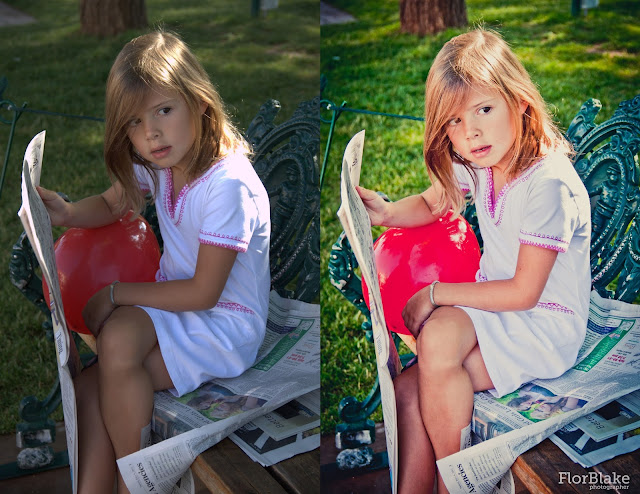


And other times, you are not so in love with the raw file, and it requires a little bit more work. You know when you take a picture and you really should have bump up that exposure another stop, but you didn't. Because I shot raw, I was able to add 1 and half stops of light to the image, dealt better with the noise, and then played with color and character. You see, raw files are your friends, it's like having a magic wand to fix your mistakes.


Yes, you have to get used to a little big more work, but at the end it is so gratifying. With amazing tools like Lightroom, Alien Skin, Photoshop, etc., you are not really adding that much work, you are creating a different workflow. 

It's worth mentioning that raw files are much bigger than JPEGs, which means, your memory card fills up quickly and your hard drive storage space runs out of room. I am on my third terabyte, however, it is a an investment I am willing to make because of the many advantages that come with the format.


So in conclusion, shooting raw allows you to record more information, get better detail, add/subtract light, easily change white-balance, and because you are creating an image from a high resolution file to begin with, your prints will be better, period. So do yourself a favor, if you are shooting digital, shoot raw and let your imagination run.


Flor Blake is a Portrait, Editorial, and Commercial Photographer based in Denver, CO.


Monday, May 12, 2014

Why I love watermarks in social media

I spend a lot of time looking at photographs, paintings, illustrations, really art in general. I also spend a lot of time on Facebook, Pinterest, StumbleUpon, and social networks similar to those. I love inspiration, I have binders with tear-sheets from all of the magazines I read with images that move me. With magazines and books is easy to have your references right there, because if I want to look up the photographer who shot a picture I like, I just look at the photo credit. Not the case with the websites I mentioned above.

Watermarks help people find you and your work. Watermarks are helpful, because when I see an image I love, I am that person that goes and finds everything that artist created. I fall in love with the body of work, with their process, I like looking at every image available and then I go and like their Facebook page, follow them on Twitter, Instagram, Behance, you name it.

There are millions of pages created in Facebook dedicated to photography, most of them share the picture, but not the creator and that drives me crazy. Same thing goes with Pinterest and even StumbleUpon. Pinterest is generally good because if you click on the picture it takes you back to the website that posted the picture initially, however, that website may not include a photo credit. Moreover, sometimes StumbleUpon pulls images off the web when you are “stumbling” but it’s just that, the image, no credit attached to it.

Why is it okay for painters to sign their work and not okay for photographers? If you have a Flickr, 500px, Facebook account, etc., watermark your work, sign it! Watermarks do not have to be intrusive, they can be include it tastefully without distracting from your image. I know that many disagree with me, but I also think is personal choice. If somebody likes your picture and wants to share, they will do so with or without the watermark.


When I first saw this picture above I was hooked, I loved it. I immediately wanted to see if the photographer had more! I checked the picture, and in the right corner, almost falling out of the picture, there is a tiny almost transparent name, Elena Kalis. Turns out, she is a super talented underwater photographer and this picture is part an amazing body of work including a series called “Alice in Waterland,” now, that’s cool! Had she not included a watermark, I don’t think I would have found her, or least not as easily.


Another example is this cartoon above. When I saw it, I was laughing so hard because it’s true for me! Anyway, somebody had shared it on Facebook, on their wall, so no link going back to his facebook page. However, this artist, Sebastien Millon, knows about watermarks and the power of them! Now I follow him on Facebook, and even have purchased postcards on his Etsy shop!

I’m not advocating for watermarks in the images on your website, I’m advocating for watermarks on your pictures on social media. You never know who will see your work or who will buy it because they were able to find you. Unless you are Annie Leibovitz, David LaChapelle, Mario Testino, Jeremy Cowart, Mark Seliger or the like, I think you could use a little bit more promotion.

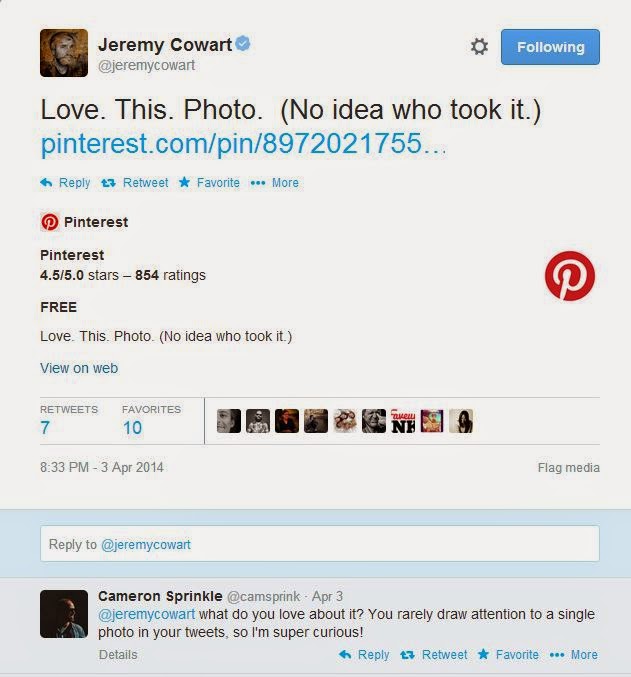
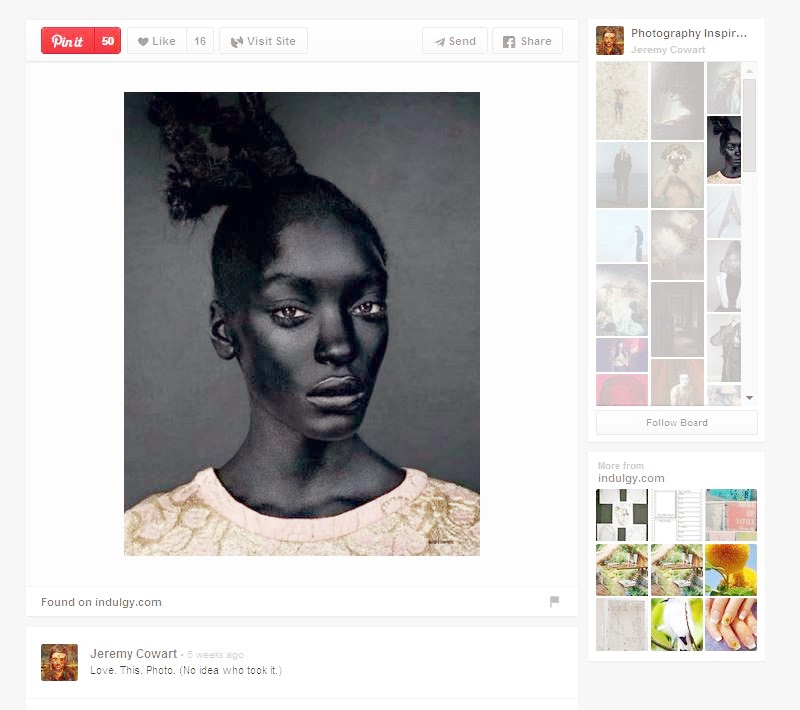
One last thing, watermarks are important in social media settings because one day Jeremy Cowart can tweet about how much he loves a picture you made, but he doesn’t know who took it! And also add the picture to his "Photography inspiration" Pinterest board!

https://twitter.com/jeremycowart/status/451925562588942337


http://www.pinterest.com/pin/89720217551065545/

So do yourself a favor and SIGN your images, you never know what's going to happen!


Monday, April 14, 2014

Fuji x100s Mini-Review

I promise I am getting to blog as fast as is humanly possible.

You may remember that I started a project that I called "Love is Love: Portraits Project" (if you haven't seen it yet head over to the link and check it out!) and that kind of has the majority of my attention, along with work, life, more work, in summary, it's good to be busy.

Three months ago, Santa thought I was really good and got me a Fuji x100s. I wanted that camera as soon as it came out , and I was so lucky that now I am the proud owner of one.

It's been three months and I've gotten to use it quite a bit. I feel I can address why I love this camera much more accurately.

REASONS WHY I LOVE THE X100S:

Size: It's small, comfortable, you can hold it with one hand!

Image quality: Hello gorgeous! That's what I feel like saying (I actually say it) the grand majority of the time that I shoot with this beauty.

Look: The throwback vintage look has me so in love. I really wanted a compact camera with a "please don't steal me" kind of look for years, and I that is something this camera really has down.

Portability: Easy to carry on your neck, your purse, perfect for travelling, street photography, documenting.

Versatility: You can do a lot with this camera, including using a pocket wizard to use off camera flash!

Funny story, my camera came straight from Japan with only one manual in Japanese, I don't speak or read the language, however, YouTube is a wonderful thing and David Hobby did a fantastic job on a step by step review of all the features of the camera on this video: And here is another review by Zack Arias.

I read both reviews and watched the videos, they are really very informative. The only two things I can add with this review that Zack and David don't talk about, (maybe they did and I missed it!) are the following:

1 - If you have the camera on silent mode, the flash will not work, you have to go into the menu settings and turn off the silent mode to use the flash. I guess you are not being very anonymous if you are using the flash, however, at least for me it's good to know, I found out the hard way!

2 - The camera has a ring around the lens that you have to remove in order to mount the hood and filter that David Hobby talks about in the video. I did not know that the ring could be removed and I spent quite a white trying to figure it out.

If you know of any other tips and tricks that are not addressed by Zack Arias, David Hobby, or any other photographer, please feel free to comment and share them, we all want to use the camera the best we can!

Here are some images I've taken over the last three months, including some images taken in my trip to San Francisco back in December and January.


 I'll be doing another blog post with more street photography from my trip to San Francisco. Hope you like these!


Friday, October 11, 2013

The Pioneer Complex and the journey of a photographer who is no longer an amateur


It’s amazing how chatty I get when I’m properly caffeinated!  I’ve been thinking over and over about a conversation I had with a photographer I recently met at a workshop.  We both talked about our careers so far, the plans and projects we have for the near future, and showed each other our work.  After I saw her work, (which by the way was really good!) we talked about Sue Bryce, Joel Grimes, and my personal favorite Chris Buck.  We also talked about Peter Lik and my friend Sarah Marino, both inspiring landscape photographers, one slightly more known than the other.  After that, she talked about how she feels that she copies a lot and how sometimes she stresses about never being a  pioneer. Even though I told her what I truly believe, which is that she doesn’t know yet if she will become a pioneer because she is still so young, (she’s younger than me!) and that copying is only natural because that’s how you find your style, these two statements stayed with me.  

All my life I knew I wanted to do something artistic. I tried music, painting, acting, drawing, even sewing, none of those stuck. I moved to New York City back in 2004 and gave acting another try, it didn’t work out.  Then I got a job at a PR office for a while, however, I was not necessarily happy. I took a photography class in college, but my professor was not very good so I lost interest.  After leaving my job at the office in 2007 I decided to try photography again and took a film photography class. Thank the heavens the instructor was amazing! He loved photography and it showed in the way he taught and talked about it, (in case you are curious to see his work his name is Michael Meyer.)  I was hooked, happy, and obsessed with this new discovery, and I wanted to become better and better with every shot I took, (especially because it was film and expensive!)  After NYC, I moved to Denver and decided to continue developing my passion.

I want to addressed the “pioneer” complex, because I was glad to find out that I am not the only one who struggles with this. 


Whoever knows me, is aware that my life is photography.  I go everywhere with a camera, I am obsessed with light, with being “innovative,” and with making interesting pictures.  I go conferences and week long, one day, and online workshops.  I watch TED Talks, documentaries about photography and photographers, and my new favorite is Mark Seliger’s Capture show.  I have more magazine subscriptions and books that I have time to read them; and I am always thinking about new gear or “new” ways to use the gear I own.  I am always thinking about a new project and have a notebook full of “ideas” I am going to do “as soon as I get some time,” (well I have a bunch of them because I have an unhealthy fascination with pretty notebooks.)  I’ve even been told a few times that I am talented, and not just by my mom or my wife. Nonetheless, every time that happens I have a hard time believing it because I am not teaching workshops, have not written a book or even been published in a national magazine.  The word “pioneer” sticks to my brain like a bad migraine.  I love learning, looking at pictures, going to museums, and creating, and hope that someday I am able to teach somebody something, but mostly I hesitate at doing so because I don’t think I have enough credentials to teach yet.  

I know or I hope I am not the only one who struggles with this and it is for this reason that I wanted to tell everybody and their mother that you are not alone.  What’s a pioneer anyway?  I looked up it’s meaning so here it goes:

pi·o·neer

 [pahy-uh-neer]
noun
one who is first or among the earliest in any field of inquiry, enterprise,
or progress.

Even if you think that you are not a pioneer, you already are, because you are probably the first in your life doing what you are doing (yes, I am getting as literal as I can), you are doing what you love, and by doing so, you are constantly learning, constantly shooting, breaking into new ground, and every time you do that, you are probably coming up with something fresh and interesting, because it is interesting to you.  

We should not be worrying about inventing the new technique or reinventing the wheel, those things are only going to happen organically if we are working. The only way to be a pioneer or be original is by doing, doing anything, trying new things, taking risks, trial and error, making mistakes, copying, going back to the drawing board and doing it again, I know it sounds cliché, but it is the truth.  You are not going to create a new technique, invent an app, a new action, even a new preset by doing the same thing you’ve been doing, you have to go outside of your comfort zone.  How many of us have hundreds of pictures that we won’t publish or even share with people close to you because you tried something new, and it didn’t work. Well now you know it doesn’t work and you will try it differently the next time.  That’s how pioneering works.


Want to copy? Well, what you probably want to do (or are already doing) is adapting or even imitating.  Notice that I am not talking about simply stealing images from another artist, but as we take classes from different instructors, we are trying out what they are teaching and then we keep what resonates with whatever aesthetic we are going for. See, copying is just reproducing, and my conversation with the photographer made me think about the difference between these concepts. Imitating is more of following something as a model or example.  Some photographers do not mind the latter. For example, Sue Bryce doesn’t mind you imitating her style because she teaches specifically that, she teaches what’s worked for her and her business and wants you to be successful using her business model and her aesthetic. But not every photographer is that way.

Adaptation is a similar animal, but when you adapt you modify fittingly.   When you use adaptation, you combine from stuff that has already been done (call it techniques, lighting, editing, etc.) to create something distinctive.  My suggestion is to do a lot research, we live in and era where information is available to us and we must take advantage of that resource; also, take tons of pictures, by taking picture after picture you find something that speaks to you. You do this over and over again, until you figure out what you want to say and you see yourself.  Imitating and adapting  are not a bad things (well, it is only bad if it’s copy and paste and you are not really shooting anything!) imitating helps you figure out who you are and who you want to be, helps you define your taste and get to know what you like and dislike.  By imitating and adapting you are trying new things, learning about what’s been done, and feeding your creativity. Want examples? Here are two:


Want to see more?  Google it, after all, Google copied Yahoo and made it better.  

Another take on “adapting” are these two successful projects, both were not first in shooting street photography or photographing dancers, but they sure gave it a cool twist:


By no means I am pretending to have this thing all figured out, I don’t.  I am still working on creating images that reveal a bit of me and make me happy. There is so much talent out there that I want to see flourish and maybe I can help somebody explore their creativity better with this post. The way I see it, you stay curious and create for yourself, by doing so, you surprise yourself, making fascinating, provocative, intriguing pieces of work, and from that, comes the satisfaction of making something you adore, adding cool new images to your portfolio helping you get closer to originality.